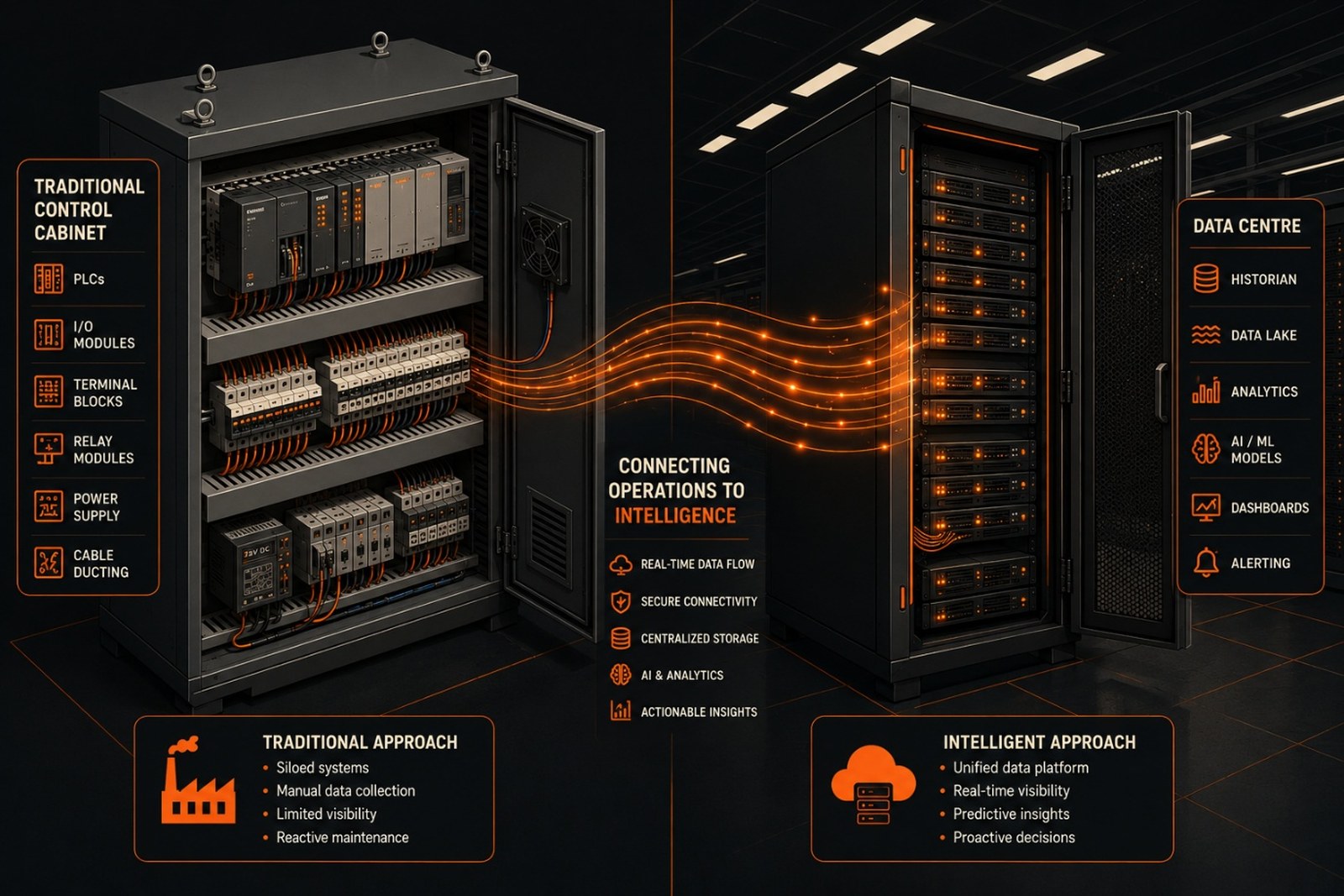
Ask three engineers to explain the difference between a PLC, a DCS and SCADA and you'll get three confident, slightly different answers. That's because the textbook distinctions were written for a world that's dissolving. Here's the honest 2026 version.
The classic division of labour
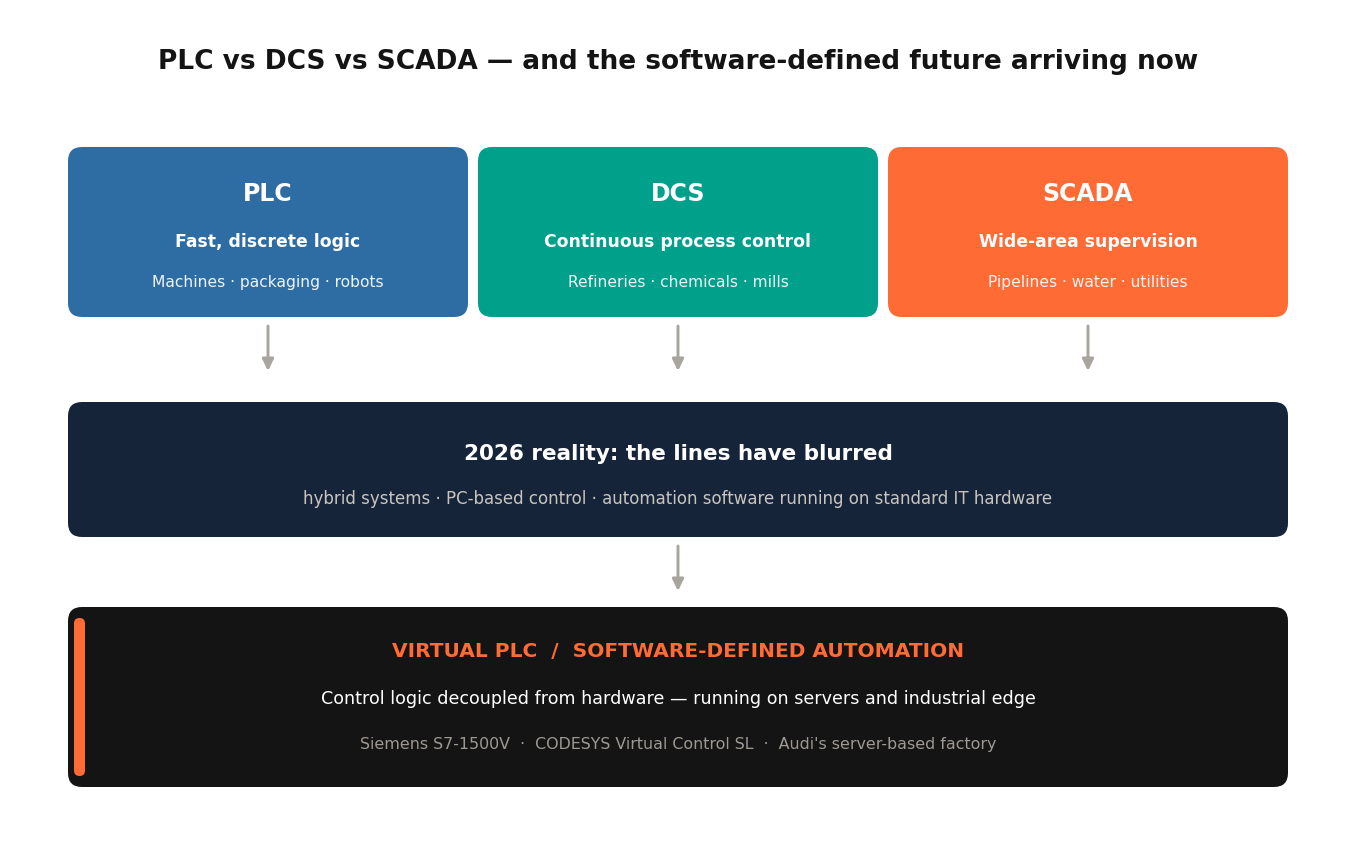
The PLC (programmable logic controller) was born to replace relay cabinets on factory floors. It excels at fast, discrete logic: interlocks, sequences, machine control. Scan times in the low milliseconds. If it moves, counts, or clamps, a PLC is probably in charge of it.
The DCS (distributed control system) grew up in refineries and chemical plants — continuous processes where hundreds of PID loops must run reliably for years, where the controller, the I/O, the HMI and the historian arrive as one engineered, redundant system. A DCS trades flexibility for integration and uptime. Nobody ever got fired for the DCS being down, because it essentially never is.
SCADA (supervisory control and data acquisition) is the wide-area layer: pipelines, water networks, power distribution — anywhere the assets are scattered across a county rather than a building. SCADA doesn't usually do the fast control itself; it supervises the remote devices that do.
Where it gets interesting: control becomes software
For fifty years, control logic and controller hardware were welded together — you bought the vendor's iron to run the vendor's code. That assumption is now breaking. Virtual PLCs decouple the control logic from the hardware entirely: the same certified runtime that used to live in a grey box on a DIN rail now runs as a container on a server or an industrial edge PC.
Update a hundred controllers the way IT updates a hundred servers. That's the pitch — and for greenfield plants it's persuasive.
This isn't a paper concept. Siemens launched the SIMATIC S7-1500V, a virtual version of its flagship controller that runs in a Docker container on generic hardware. CODESYS ships Virtual Control SL and demonstrates software-defined automation at every major trade fair. And Audi — about as demanding an automation user as exists — has been running virtual PLCs in series production since January 2024 under its Edge Cloud 4 Production programme, replacing decentralised industrial PCs on the shop floor with centralised server clusters. The pilot at its Böllinger Höfe plant included what Audi claims is the first fully virtualised, TÜV-certified control system for safety-critical production, and the rollout is now heading to Neckarsulm.
The caveats an honest engineer should keep
vPLCs are still young, and the gaps are specific rather than vague. Until recently no virtual PLC could reliably serve control tasks needing execution faster than about one millisecond, which rules out the fastest motion and high-speed machine work. Redundancy models are thinner than the hot-standby arrangements a DCS gives you as standard. And code portability is largely a promise: moving logic between one vendor's runtime and another's generally still means modifying it, which is a strange fate for a technology whose whole pitch is hardware independence.
Functional safety, though, is the caveat that moved fastest. It was the obvious blocker two years ago and it is now partly solved — CODESYS ships an SIL3-certified virtual safety controller that doesn't require certified hardware underneath it, and Audi's TÜV-certified installation exists in a real factory. Watch this one; it is the difference between vPLCs being a convenience and being a genuine replacement.
Where does that leave the timeline? IoT Analytics, which tracks this market closely, reckons roughly a quarter of new PLC sales could be virtual or soft by 2030 — real momentum, but their assessment is that vPLCs won't be the industry norm by the decade's end. That sounds about right. The installed base is enormous, hard PLCs are cheap and famously reliable, and plants replace control systems on twenty-year cycles, not product-launch cycles. But every automation vendor is now building toward this future, which tells you where the puck is going.
What this means for your career
The skill that's appreciating fastest isn't ladder logic or any single vendor's toolchain — it's the ability to think across the boundary. Networking, virtualisation, containers, version control: the IT disciplines are arriving in OT, and the engineers who speak both languages get the interesting projects. Learn a PLC platform deeply (you must — the installed base is enormous and it pays the bills), but learn Linux and networking alongside it. That combination is rare and plants know it.
Key takeaways
- PLC = fast discrete logic, DCS = integrated continuous process control, SCADA = wide-area supervision. Know the classic split — interviews still test it.
- Virtual PLCs decouple control software from hardware; Audi has run them in series production since 2024 and is expanding the rollout.
- The real remaining gaps are sub-millisecond control, redundancy and code portability. Functional safety certification has already started to fall.
- Around a quarter of new PLC sales could be virtual or soft by 2030 — significant, but not yet the industry norm.
- The premium skill is bilingualism: deep OT fundamentals plus IT skills (networking, Linux, containers).
What’s your take?
Would you trust a virtual PLC with a safety function today — or is that still a few years away in your plant? Join the conversation.
A 12-part journey from the sensor to the self-driving plant.
All twelve parts — building from the 4–20 mA loop all the way to plants that run themselves. Brought to you by SynapseAI.
▦ See the full 12-part roadmap →
Building or running industrial automation?
See how SynapseAI helps vendors win markets and plant teams work smarter.