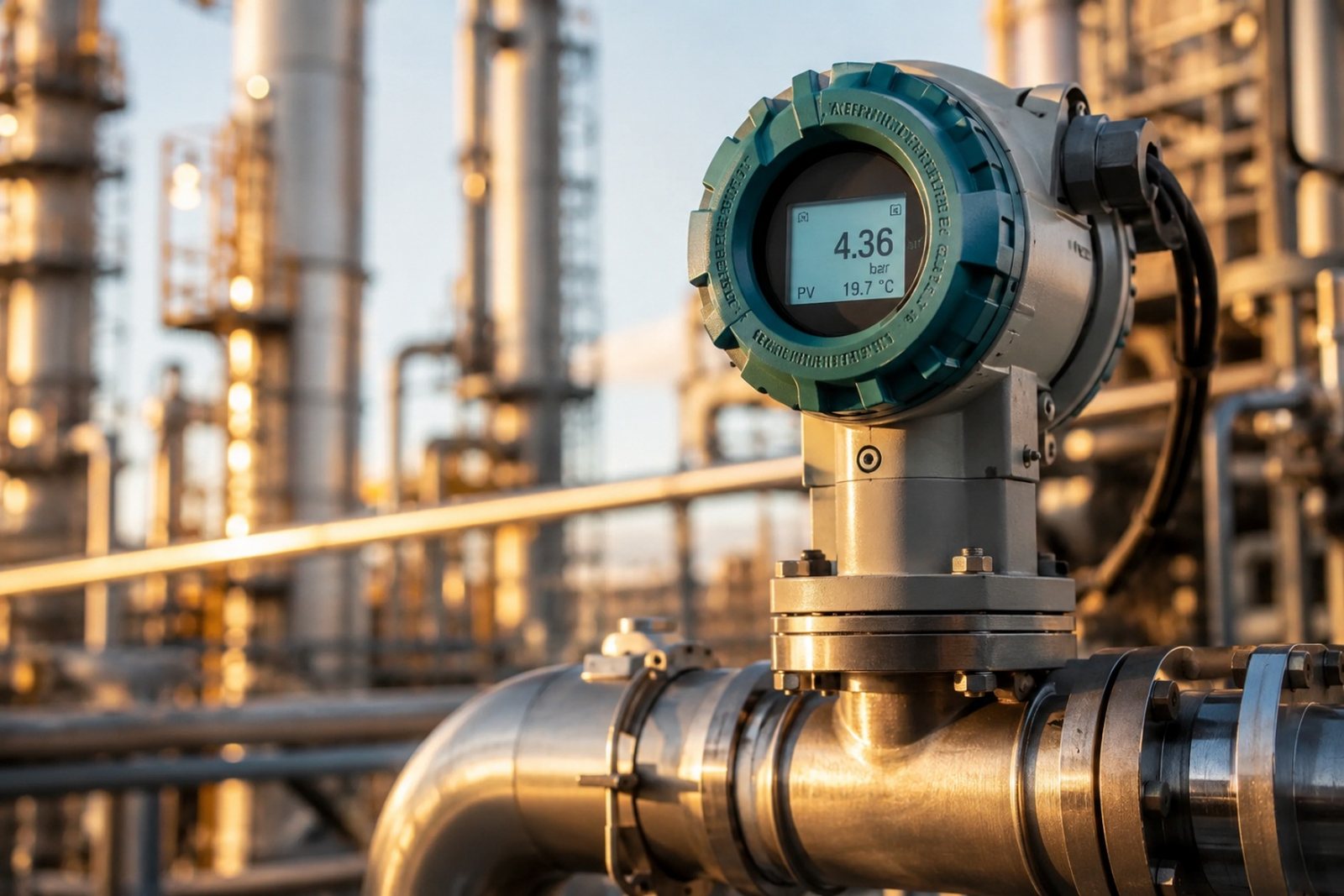
Every clever thing a plant does — every AI model, every dashboard, every autonomous decision — starts with a measurement. If the measurement is wrong, everything above it is confidently wrong. That's why experienced engineers are slightly obsessive about instrumentation, and why your first years on site will teach you more about sensors than any degree module did.
Why 4–20 mA conquered the world
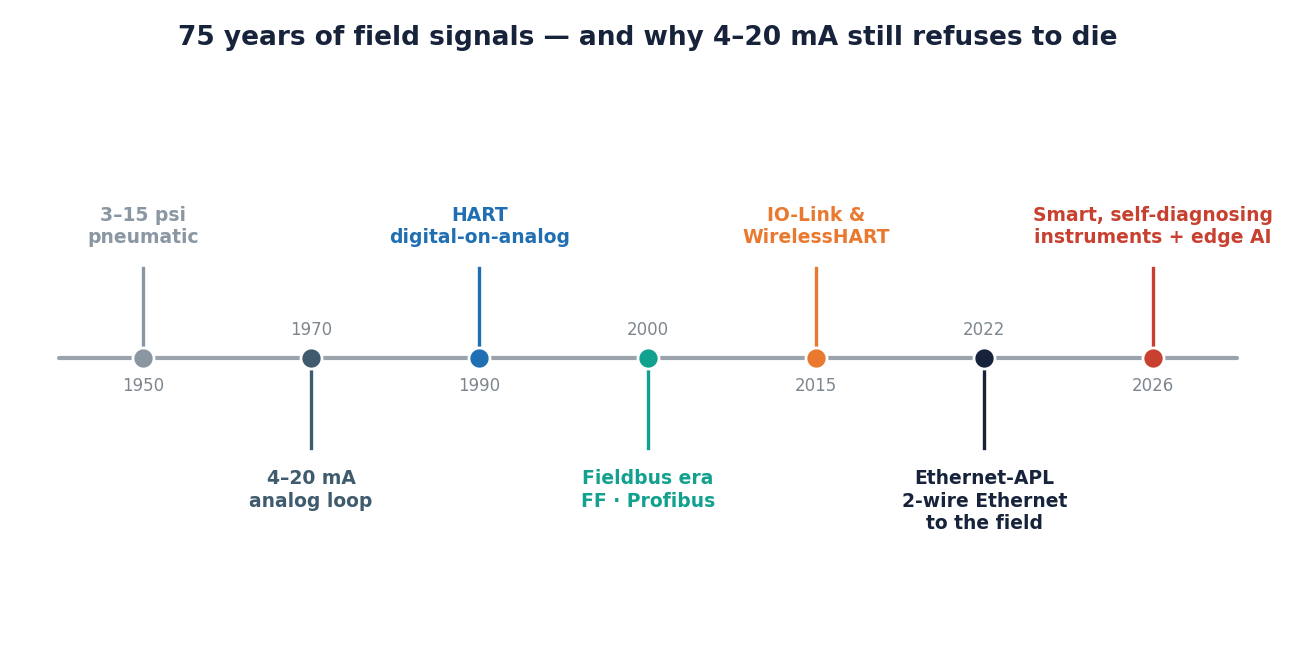
In the 1950s plants ran on pneumatic signals: 3–15 psi of air pressure carrying measurements through copper tubing. Then came the analog current loop, and it was quietly brilliant. Represent zero measurement as 4 milliamps and full scale as 20. Because "zero" is 4 mA rather than 0, a broken wire (0 mA) announces itself instantly — the dead signal is distinguishable from a low reading. Current doesn't degrade over long cable runs the way voltage does, and the same two wires can power the transmitter. Simple, robust, self-diagnosing by accident.
That's why, in 2026, with 5G in the plant and LLMs in the control room, most new process instruments still ship with 4–20 mA. Standards this good die slowly. You will wire one in your first month on the job.
The intelligence crept in gradually
HART was the first hack: superimpose a digital signal on top of the analog 4–20 mA loop, so the same wire that carries the measurement can also carry diagnostics, range settings, and calibration data. Then came the fieldbus era — FOUNDATION Fieldbus, Profibus — which went fully digital but fragmented into competing camps and never achieved the universal adoption its backers hoped for. IO-Link brought cheap point-to-point digital connectivity to discrete sensors.
The genuinely exciting development is Ethernet-APL: two-wire Ethernet, intrinsically safe for hazardous areas, delivering power and 10 Mbit/s data to field instruments over the same cable types plants already have. It means the transmitter on a distillation column can be a first-class citizen of the plant network — no gateways, no protocol translation. Instrument vendors are now shipping APL natively, and new plants are being designed around it.
When the sensor becomes a colleague
A modern smart transmitter doesn't just report pressure. It reports its own health: plugged impulse lines, drifting electronics, loss of calibration. Multiply that by the five thousand instruments in a mid-size plant and you get a continuous stream of early warnings — if anyone is listening. Most plants aren't. The diagnostics sit unread inside the device, which is roughly like owning five thousand smoke detectors and never checking the batteries.
This is where the AI story quietly begins, two articles before we officially get to AI. Edge devices can now aggregate instrument diagnostics and flag the ones that matter. The plants doing this well aren't the ones with the biggest budgets — they're the ones whose engineers know the instruments well enough to know which warnings are real. That knowledge is built standing next to a technician with a multimeter, not in a dashboard.
Key takeaways
- Every intelligent system in a plant is only as good as the measurements feeding it — instrumentation is the foundation of everything in this series.
- 4–20 mA survived 75 years because it's self-diagnosing, noise-tolerant and dead simple; you'll still wire it in 2026.
- Ethernet-APL puts field instruments directly on the plant network — two wires, hazardous-area safe, no gateways.
- Smart instruments already generate rich diagnostics; most plants ignore them. Being the engineer who listens is an easy way to stand out.
What’s your take?
Still wiring 4–20 mA in 2026, or gone all-in on APL? Got a war story from your own plant? Join the conversation.
A 12-part journey from the sensor to the self-driving plant.
All twelve parts — building from the 4–20 mA loop all the way to plants that run themselves. Brought to you by SynapseAI.
Building or running industrial automation?
See how SynapseAI helps vendors win markets and plant teams work smarter.